Parsing SystemVerilog Source Text
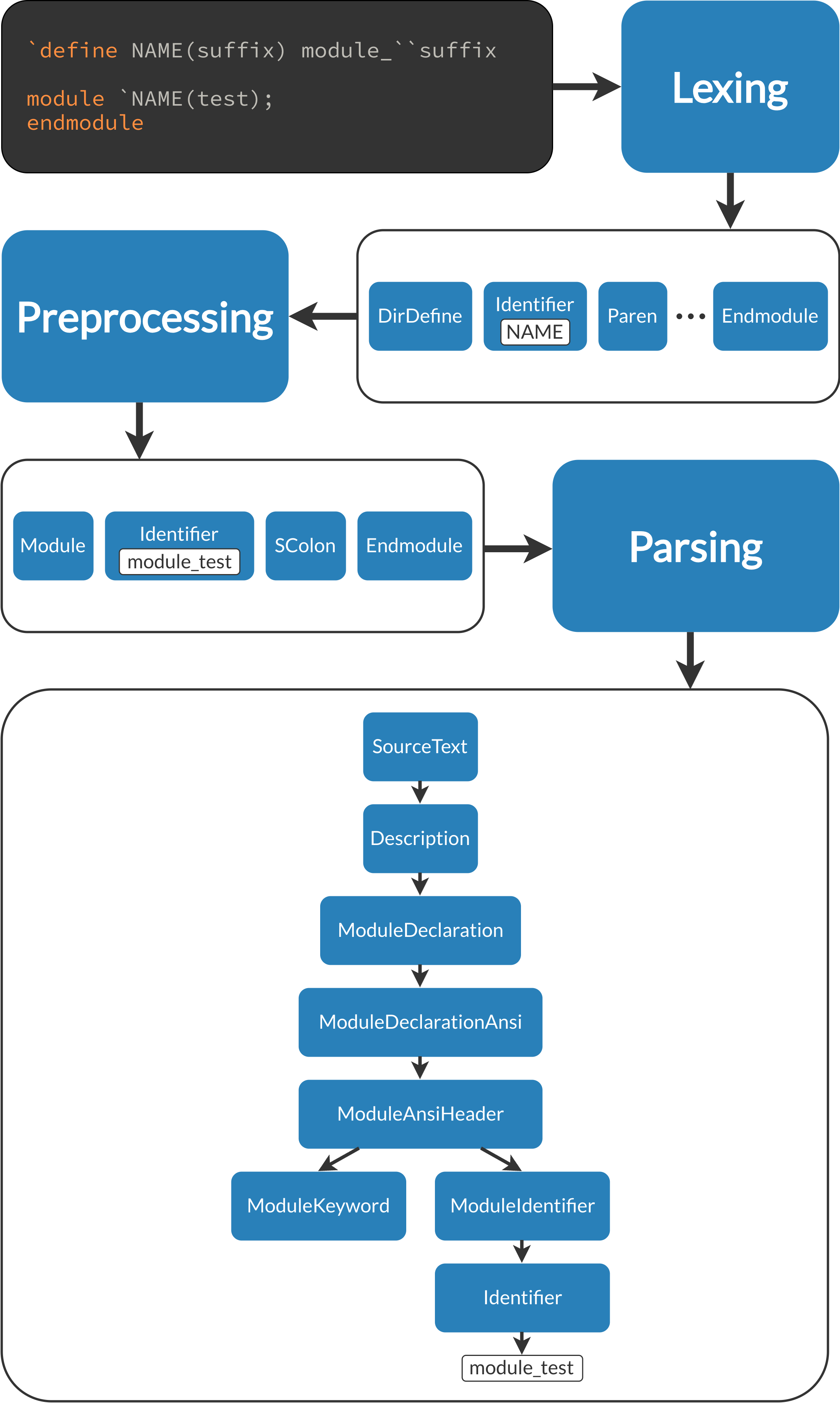
Parsing source code involves creating a CST (Concrete Syntax Tree) out of
raw text, so that the structure of the code can be understood and operated
on. scarf separates this process out into three common phases:
Lexing: Separate the file content into individual semantic tokens
Preprocessing: Elaborate any preprocessor/compiler directives
Note that this requires destructively changing the token stream, and is a one-way operation; a source file cannot be recovered from a CST (although an equivalent one with no preprocessor directives could be constructed)
Parsing: Organize the tokens into a tree of SystemVerilog language constructs (as defined in IEEE 1800-2023, Annex A)
CST vs. AST
scarf specifically produces a CST, not an AST (Abstract Syntax Tree),
as location information is retained throughout parsing. Lexing and
preprocessing both produce streams of SpannedToken, which
associate each lexical Token with a Span
identifying where it belongs in the source file. Similarly, a Node
in the tree produced by parsing has a Node.span attribute
Lexing
The lex() function is provided to separate a source file into
a stream of spanned tokens (SpannedToken). Each Token
is one of many subclasses (which can be checked using isinstance, or
structural pattern matching if using Python 3.10+). A Token.Error
indicates a section that wasn’t recognized as a valid slice of SystemVerilog
text.
Lexing requires both the content of the source file, as well as its name
(to use as the file name in Spans).
Preprocessing
To preprocess a file from the initial source text, use the
preprocess() function, which combines the lexing and preprocessing
steps. This lexes the source file, and then elaborates any and all
preprocessor/compiler directives, such as conditional directives, text macros,
etc. The output of preprocess() is a PreprocessorResult;
this either contains a successfully preprocessed stream of SpannedToken,
or a PreprocessorError(s) explaining what went wrong.
In addition to the file content and name, preprocess() also requires
a list of include paths (to search when expanding include directives),
as well as any initial preprocessor definitions - see Define.
If you feel the need to modify the token stream in between lexing and
preprocessing, you can use preprocess_from_lex() to preprocess an
existing token stream; however, this incurs substantial overhead when
compared to preprocess() due to copying data between Rust and
Python ownership models, and isn’t recommended.
Parsing
To parse a file from the initial source text, use the parse()
function. This has the same inputs as preprocess(), but instead
parses the token stream into a Concrete Syntax Tree. The output of parse()
is a ParserResult that either contains the root Node of
the CST, or either a PreprocessorError(s) from preprocessing
or a VerboseError from parsing.
Given the root Node, the tree structure can be traversed
manually with the Node.children attribute (accessing the direct
child Nodes of the Node); however, Nodes
are also iterable (ex. for child_node in node:), which users may prefer
to traverse the tree. The iterable syntax traverses all Nodes
in the tree, depth-first. Users may find it helpful to reference the
underlying Rust documentation
for the CST structure when writing applications.
If you feel the need to modify the token stream in between preprocessing and
parsing, you can use parse_from_preprocess() to parse an
existing token stream; however, this incurs substantial overhead when
compared to parse() due to copying data between Rust and
Python ownership models, and isn’t recommended.
An example program that finds blocking assignments in always_ff blocks
might look like the following
from scarf_python import Node, Span, parse, ParserResult

def is_always_ff_block(node: Node) -> bool:
  if not node.name == "AlwaysConstruct":
    return False
  for node in node.children:
    if (node.name == "AlwaysKeyword") and (node.text == "always_ff"):
      return True
  return False

def blocking_assignments(node: Node) -> list[Span]:
  spans: list[Span] = []
  for child_node in node:
    if child_node.name == "BlockingAssignment":
      spans.append(node.span)
  return spans

with open("my_file.v", "r") as f:
  content = f.read()

include_paths = ["."]
defines = []
parse_result = parse(content, "my_file.v", include_paths, defines)
assert isinstance(parse_result, ParserResult.Ok)

bad_blocking_assignments: list[Span] = []
for node in parse_result.root:
  if is_always_ff_block(node):
    bad_blocking_assignments.extend(blocking_assignments(node))

print(f"Found {len(bad_blocking_assignments)} bad blocking assignments!")